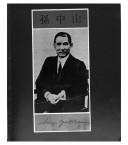
Shanghai Ball Photo Studio · Public domain (via Wikimedia Commons)
Sun Yat-sen
Sun Yat-sen (November 12, 1866 - March 12, 1925) was named Wen when he was studying, and his name was Zai. His musical name was Deming, and his childhood name was Dixiang. In 1886, he changed his name to Yixian, and in 1897 he changed his name to Zhongshan Qiao. A native of Cuiheng Township, Xiangshan, Guangdong (now Zhongshan City). Sun Yat-sen was a statesman and revolutionary in the late Qing Dynasty who made significant and far-reaching contributions to the development of democratic politics in modern China. The great pioneer of the democratic revolution and the founder of the Republic of China. In 1892, Sun Yat-sen graduated from the Hong Kong College of Western Medicine and practiced medicine in Macau and Guangzhou. In 1894, Sun Yat-sen wrote to Li Hongzhang, proposing revolutionary politics but was rejected, so he went to Honolulu to organize the Revival of China Conference, proposing the slogan "Revitalize China" and a political platform of "Expelling the Tartars, restoring China, and establishing a United Government." In 1895, the Xingzhonghui launched the Yiwei Guangzhou Uprising. In 1905, Sun Yat-sen formed the China League in Tokyo, Japan, and was elected as Prime Minister. He established the revolutionary political platform of "driving out the Tartars, restoring China, establishing the Republic of China, and equalizing land rights," and proposed the Three People's Principles. He founded the People's Daily, promoted the revolution, and engaged in fierce debates with the Chinese reformists at the time. Since then, Sun Yat-sen developed revolutionary organizations at home and abroad, contacted overseas Chinese, the Communist Party of China and the New Army, and launched many armed uprisings. In October 1911, the Wuchang Uprising occurred, and all provinces responded to it. On December 29, Sun Yat-sen was elected as the provisional president of the Republic of China by representatives of the seventeen provinces in Nanjing. He was proclaimed in office in Nanjing on January 1, 1912 (the first year of the Republic of China), established the provisional government of the Republic of China, and formed the provisional Senate at the end of the month. On February 13, due to the compromise between the revolutionaries and Yuan Shikai, Sun Yat-sen was forced to resign; in March, the Provisional Senate passed the "Provisional Constitution of the Republic of China" formulated under the chairmanship of Sun Yat-sen; in August, the China League was reorganized into the Kuomintang, and Sun Yat-sen was elected as chairman. In March 1913, when Kuomintang leader Song Jiaoren was shot and killed at Shanghai North Railway Station, Sun Yat-sen immediately launched an army to attack Yuan, but failed and fled to Japan. In 1914, Sun Yat-sen established the Chinese Revolutionary Party in Japan, raised the banner of revolution, and issued two declarations to attack Yuan. In 1917, Duan Qirui dissolved the National Assembly, and Sun Yat-sen held an extraordinary session of the National Assembly in Guangzhou to organize a military government to protect the law. He was elected as Grand Marshal and vowed to fight for the Northern Expedition. The following year, he was hijacked by the old Guangxi warlords and the political science department, and was forced to resign and go to Shanghai. In 1919, Sun Yat-sen founded the magazine "Construction", published "Industrial Plan", and reorganized the Chinese Revolutionary Party into the Chinese Kuomintang. Sun Yat-sen returned to Guangdong in 1920 and took office as the Very President the following year. In 1922, he retired to Shanghai due to the Chen Jiongming Incident. communism in china
- Category
- Political figures
- Nationality
- Republic of China
- Born
- 1866-11-12
- Died
- 1925-03-12
- Wikidata
- Q8573